Tuesday, March 22, 2016

American College of Pediatricians Calls Transgender Ideology "Child Abuse."

The American College of Pediatricians issued a strongly worded statement that transgender ideology is "child abuse" and that “a person’s belief that he or she is something they are not is, at best, a sign of confused thinking.”

This seems like something. A bunch of you are smarter and more knowledgeable about these subjects so I wonder what you have to say about this. But it seems pretty counter-cultural to me.

Here's some highlights:
The American College of Pediatricians urges educators and legislators to reject all policies that condition children to accept as normal a life of chemical and surgical impersonation of the opposite sex. Facts – not ideology – determine reality.

1. Human sexuality is an objective biological binary trait: “XY” and “XX” are genetic markers of health – not genetic markers of a disorder. The norm for human design is to be conceived either male or female. Human sexuality is binary by design with the obvious purpose being the reproduction and flourishing of our species. This principle is self-evident. The exceedingly rare disorders of sex development (DSDs), including but not limited to testicular feminization and congenital adrenal hyperplasia, are all medically identifiable deviations from the sexual binary norm, and are rightly recognized as disorders of human design. Individuals with DSDs do not constitute a third sex.1

3. A person’s belief that he or she is something they are not is, at best, a sign of confused thinking. When an otherwise healthy biological boy believes he is a girl, or an otherwise healthy biological girl believes she is a boy, an objective psychological problem exists that lies in the mind not the body, and it should be treated as such. These children suffer from gender dysphoria. Gender dysphoria (GD), formerly listed as Gender Identity Disorder (GID), is a recognized mental disorder in the most recent edition of the Diagnostic and Statistical Manual of the American Psychiatric Association (DSM-V).5 The psychodynamic and social learning theories of GD/GID have never been disproved.2,4,5

The report goes on to say that puberty-blocking hormones are dangerous and that while many young men and women can become confused about their gender, that "98% of gender confused boys and 88% of gender confused girls eventually accept their biological sex after naturally passing through puberty." 

And then there's this which has been known but little discussed but seems kind of important because...death. But to many people, people dying is secondary to the furtherance of their ideology:

Rates of suicide are twenty times greater among adults who use cross-sex hormones and undergo sex reassignment surgery, even in Sweden which is among the most LGBQT – affirming countries.11 What compassionate and reasonable person would condemn young children to this fate knowing that after puberty as many as 88% of girls and 98% of boys will eventually accept reality and achieve a state of mental and physical health?

And then they say "Conditioning children into believing a lifetime of chemical and surgical impersonation of the opposite sex is normal and healthful is child abuse."

Seems kinda' wow to me.

LINK

Saturday, February 27, 2016

"SILENCE IN THE LITURGY by Cardinal Robert Sarah


It is important to recall that silence is a necessary condition for deep, contemplative prayer, and an important component of the liturgy.

Many Catholics rightly complain about the absence of silence in some forms of the celebration of our Roman liturgy. It seemed to us important, therefore, in this short essay, to recall the meaning of silence as a Christian ascetical value, and therefore as a necessary condition for deep, contemplative prayer, without forgetting the fact that times of silence are officially prescribed during the celebration of the Holy Eucharist, so as to highlight the importance of silence for a high-quality liturgical renewal.

1. Silence as a Christian ascetical value

In the negative sense, silence is the absence of noise. It can be exterior or interior. Exterior silence involves the absence of sounds both in words and in actions (noises of doors, vehicles, jackhammers, and airplanes, the noisy mechanism of cameras, often accompanied by dazzling flashes, and also of that horrible forest of cell phones that are brandished at arm’s length during our Eucharistic liturgies). Virtuous or mystical silence obviously must be distinguished from reproachful silence, from the refusal to speak to someone, from the silence of omission through cowardice, egotism, or hard-heartedness.

Of course, exterior silence is an ascetical exercise of self-mastery in the use of speech. First of all it may be helpful to recall what asceticism is; this word is not praised to the skies by our consumer society—far from it!—and, we must admit, it frightens our contemporaries, including very often the Christians who are influenced by the spirit of the world. Well, then, what is asceticism? Asceticism is an indispensable means that helps us to remove from our life anything that weighs it down, in other words, anything that hampers our spiritual or interior life and therefore is an obstacle to prayer. Yes, it is indeed in prayer that God communicates his Life to us, in other words, manifests his presence in our soul by irrigating it with the streams of his Trinitarian Love: the Father through the Son in the Holy Spirit. And prayer is essentially silence. Chattering, the tendency to externalize all the treasures of the soul by expressing them, is supremely harmful to the spiritual life. Carried away toward the exterior by his need to say everything, the chatterer cannot help being far from God, superficial and incapable of any profound activity.

The wisdom books of the Old Testament (Prov 10:8, 11, 13, 14, 18-21, 31, 32; 15:1-7; Sir 19:7-12; 20:1-2, 5-8 or 23:7-15; 28:13-26) are chock-full of exhortations aimed at avoiding sins of the tongue (in particular, slander and calumny). The prophetic books, for their part, mention silence as the expression of reverential fear of God; it is then a preparation for the theophany of God, in other words, the revelation of His presence in our world (Lam 3:26; Zeph 1:7; Hab 2:20; Is 41:1; Zech 2:13). The New Testament is not outdone in this respect. Indeed, there is the Letter of James, which clearly remains the classic passage about controlling the tongue (Jas 3:1-10). However, we know that Jesus himself warned us against wicked words, which are the expression of a depraved heart (Mt 15:19) and even against idle words, for which an accounting will be demanded of us (Mt 12:36). In contrast, we can only be impressed by the silence of Jesus before the Sanhedrin, the Roman governor Pilate and King Herod: Jesus autem tacebat (Mt 26:63). Herod asked him to work a miracle for him personally, and his courtiers would have been amused by it. But Jesus Christ, who was in chains—he, the God of majesty—did not consent to become the buffoon of King Herod, nor to do for that proud man whose curiosity was unhealthy what he granted so generously to the humble and the uneducated.

In reality, true, good silence always belongs to someone who is willing to let others have his place, and especially the Completely-Other, God. In contrast, external noise characterizes the individual who wants to occupy an over-important place, to strut or to show off, or else who wants to fill his interior emptiness, as is the case in many stores and public facilities, and also particularly in the waiting rooms of some dentists, hairdressers..., where they impose incessant background music on you.

As for interior silence, it can achieved by the absence of memories, plans, interior speech, worries…. Still more important, thanks to an act of the will, it can result from the absence of disordered affections or excessive desires. The Fathers of the Church assign an eminent place to silence in the ascetical life. Think of Saint Ambrose (In psalm. 37, 12-15), Saint Augustine, Saint Gregory the Great (Moralia II, 48; XXII, 16; XXX, 16), not to mention Chapter VI of the Rule of Saint Benedict of Nursia on “taciturnity,” or Chapter 62 on grand silence at night, where he adopts the teaching of Cassian. Starting with those spiritual masters, all the medieval founders of religious orders, followed by the mystics of the Catholic Counter-Reformation, insisted not only on the ascetical but also on the mystical importance of silence.

2. Silence as a condition for contemplative prayer

The Gospels say that the Savior himself prayed in silence, particularly at night (Lk 6:12), or while withdrawing to deserted places (Lk 5:16; Mk 1:35). Silence is typical of the meditation by the Word of God; we find it again particularly in Mary’s attitude toward the mystery of her Son (Lk 2:19, 51). The most silent person in the Gospels is of course Saint Joseph; not a single word of his does the New Testament record for us. Saint Basil considers silence not only as an ascetical necessity of monastic life, but also as a condition for encountering God (Letter 2, 2-6: PG 32, 224-232). Silence precedes and prepares for the privileged moment when we have access to God, who then can speak to us face to face as we would do with a friend (cf. Ex 33:11; Num 12:8; Deut 34:10).

Recall, in this regard, that we arrive at the knowledge of God by way of causality, analogy, eminence, but also negation: once we affirm the divine attributes, which are known by natural reason (this is the kataphatic way), we must deny the mode of limited realization thereof that we know here below (this is the apophatic way). Silence is an essential part of the apophatic way of gaining access to God, which was so highly prized by the Fathers of the Church, especially the Greeks; this makes them demand silence of arguments when faced with the mystery of God (Clement of Alexandria, Gregory Nazianzen, Gregory of Nyssa).

It is nonetheless true that silence is above all the positive attitude of someone who prepares to welcome God by listening. Yes, God acts in the silence. Hence this very important remark by the great Saint John of the Cross: “The Father said only one word, namely his Son, and in an eternal silence he always says it: the soul too must hear it in silence.” The Book of Wisdom had already noted in this regard the manner in which God intervened to deliver the chosen people from captivity in Egypt: that unforgettable act took place during the night: “For while gentle silence enveloped all things, and night in its swift course was now half gone, your all-powerful word leaped from heaven, from the royal throne” (Wis 18:14). Later, this verse would be understood by Christian liturgical tradition as a prefiguration of the silent Incarnation of the Eternal Word in the crib in Bethlehem. As for Blessed Elizabeth of the Trinity, she would insist on silence as a condition for contemplating God the Holy Trinity.

And so we have to make silence: this is of course an activity, and not a form of idleness. If our “interior cell phone” is always busy because we are “having a conversation” with other creatures, how can the Creator reach us, how can he “call us”? We must therefore purify our mind of its curiosities, the will of its plans, in order to open ourselves totally to the graces of light and strength that God wants to give us profusely: “Father, not my will, but yours be done.” Ignatian “indifference” is therefore a form of silence too.

3. The silence prescribed by the liturgical norms

Prayer is a conversation, a dialogue with the Triune God: although at some moments we address God, at others we make silence so as to listen to him. It is not surprising therefore that we must consider silence as an important component of the liturgy. Of course the Eastern rites (which are not within the competence of my Congregation) plan no times of silence during the Divine Liturgy. Indeed, when the priest himself does not chant, in other words, when he prays in silence (or “secretly,” which comes from the Latin word: secreto), particularly during the anaphora, i.e., the Eucharistic Prayer, except for the words of consecration, which are chanted aloud, we can note that the deacon, the choirs, or else the faithful chant without interruption. Nevertheless, they are intensely aware of the apophatic dimension of their prayer, which is expressed by all sorts of adjectives and adverbs describing the Supreme Master of the Universe and Savior of our souls. For example, the “preface” of the Byzantine rite says this: “You are God—ineffable, inconceivable, invisible, incomprehensible….” Moreover, in its essentials, the Divine Liturgy is something of a plunge into the “Mystery,” which means, concretely, that it is celebrated behind the iconostas, and the priest, who stands at the altar of Sacrifice, often prays in silence.

In the West, in contrast, in all its rites (Roman, Roman-Lyonese, Carthusian, Dominican, Ambrosian, etc.) the silent prayer of the priest was not ceaselessly accompanied by the chanting of the choir or of the congregation. The Latin Mass therefore has always included times of complete silence. Until the reform of Blessed Pope Paul VI, this was the case especially during the Canon, or Eucharistic Prayer, which was pronounced by the celebrant in silence (secreto), except in the rare cases of sacramental concelebration. It is true that in some places they had tried to fill up the emptiness of this silence lasting several minutes (five to eight at most) which, in reality, was only apparent, by the sound of the organ, or by polyphonic singing, but it must be admitted that this practice was not in keeping with the spirit of these rites.

Vatican Council II prescribed keeping a time of silence during the Eucharistic Sacrifice. Thus the Constitution on the Liturgy Sacrosanctum Concilium, §30, decreed that “to promote active participation…at the proper time a reverent silence should be observed.” The General Introduction to the Roman Missal (GIRM) of Blessed Pope Paul VI, revised in 2002 by Saint John Paul II, specified the many places in the Mass where it is necessary to observe such silence. We find first of all this general reminder, which explains SC 30 (cited above):

Sacred silence also, as part of the celebration, is to be observed at the designated times (Sacrosanctum Concilium, art. 30; Instruction Musicam sacram, n. 17).[2] Its nature, however, depends on the moment when it occurs in the different parts of the celebration. For in the Penitential Act and again after the invitation to pray, individuals recollect themselves; whereas after a reading or after the Homily, all meditate briefly on what they have heard; then after Communion, they praise God in their hearts and pray to him. Even before the celebration itself, it is a praiseworthy practice for silence to be observed in the church, in the sacristy, in the vesting room, and in adjacent areas, so that all may dispose themselves to carry out the sacred celebration in a devout and fitting manner. (GIRM, no. 45 [formerly 23])
 How sad it is—it’s almost a sacrilege—to hear sometimes priests and bishops chattering uninterruptedly in the sacristy, and even during the entrance procession, instead of recollecting themselves and contemplating in silence the mystery of the death of Christ on the Cross that they are getting ready to celebrate, which ought to inspire them with nothing but fear and trembling!

The first moment in particular in which silence is prescribed is the penitential preparation: “The Priest calls upon the whole community to take part in the Penitential Act, which, after a brief pause for silence, it does by means of a formula of general confession” (GIRM, n. 51 [29]). Then, for the collect: “…the Priest calls upon the people to pray and everybody, together with the Priest, observes a brief silence so that they may become aware of being in God’s presence and may call to mind their intentions” (GIRM, n. 54 [32]; cf. n. 127 [88]). Then, “the Liturgy of the Word is to be celebrated in such a way as to favor meditation, and so any kind of haste such as hinders recollection is clearly to be avoided. In the course of it, brief periods of silence are also appropriate, accommodated to the assembled congregation; by means of these, under the action of the Holy Spirit, the Word of God may be grasped by the heart and a response through prayer may be prepared. It may be appropriate to observe such periods of silence, for example, before the Liturgy of the Word itself begins, after the First and Second Reading, and lastly at the conclusion of the Homily” (GIRM, n. 56). Paragraph n. 128 [89] is entirely in keeping with this recommendation for the First Reading, and n. 130 [91] for the Second Reading. This advice applies also to the homily, which must be received and assimilated in an atmosphere of prayer (cf. GIRM, n. 66 [42] and 136 [97]). Finally it becomes a genuine prescription addressed to the faithful for the Eucharistic Prayer, when “the people, for their part, should associate themselves with the priest in faith and in silence…” (GIRM, n. 147 [108]).

We find again the possibility of remaining in silence after Holy Communion (cf. GIRM, n. 164 [121]), or to prepare to listen to the “Postcommunion” prayer (GIRM, n. 165 [122]). In Mass celebrated in the absence of a congregation, a moment of silence is even recommended to the celebrant: “After the purification of the chalice, the Priest should observe a brief pause for silence...” (GIRM, n. 271 [230]).

Silence is therefore not at all absent from the Ordinary Form of the Roman Rite, at least if we follow its guidelines and celebrate in the spirit of its recommendations. Unfortunately, too often “it was forgotten that the Council also included silence under actuosa participatio, for silence facilitates a really deep, personal participation, allowing us to listen inwardly to the Lord’s word. Many liturgies now lack all trace of this silence.”[3] Moreover, apart from the homily, all other speeches or introductions of persons should be forbidden during the celebration of Holy Mass. Indeed, we have to avoid turning the church, which is the house of God intended for adoration, into a theater in which people come to applaud the actors who are rated according to their ability to communicate, to use an expression that you often hear in the media. Nowadays, you sometimes get the impression that
Catholic worship…has gone from adoration of God to the exhibition of the priest, the ministers, and the faithful. Piety has been abolished, including the word itself, and has been liquidated by liturgists as devotionalism, but they have made the people put up with liturgical experiments and rejected spontaneous forms of devotion and piety. They have even succeeded in imposing applause on funerals in place of mourning and weeping. Did Christ not mourn and weep at the death of Lazarus? “Wherever applause breaks out in the liturgy…it is a sure sign that the essence of the liturgy has totally disappeared….”
 4. The importance of silence for the quality of the liturgy

Finally, we must strive to understand the motivations of this liturgical discipline concerning silence and to become imbued with it. Two particularly well-qualified authors may help us in this area, and therefore succeed in convincing us of the need for silence in the liturgy. In the first place, Msgr. Guido Marini, Master of Pontifical Ceremonies, expresses the general principle in these terms:

A well celebrated liturgy, in its different parts, plans a happy alteration of silence and speech, in which silence animates speech, allows the voice to resonate with an extraordinary depth, and keeps each verbal expression in the right atmosphere of recollection…. The required silence must not…be considered as a pause between one moment in the celebration and the next. Rather, it should be considered as a true moment of the ritual, complementing the words, the vocal prayer, the song, and the gestures.
 Indeed, Joseph Cardinal Ratzinger had already noted in his famous book, The Spirit of the Liturgy:

[S]ilence is part of the liturgy…. [T]he greater mystery, surpassing all words, summons us to silence. It must, of course, be a silence with content, not just the absence of speech and action. We should expect the liturgy to give us a positive stillness that will restore us. Such stillness will not be just a pause, in which a thousand thoughts and desires assault us, but a time of recollection, giving us an inward peace, allowing us to draw breath and rediscover the one things necessary….
his is therefore a silence in which we simply look at God and allow God to look at us and to envelop us in the mystery of his majesty and love.

Cardinal Ratzinger also mentioned several particular moments of silence, for example this one:

In some places, the Preparation of the Gifts is intended as a time for silence. This makes good sense and is fruitful, if we see the Preparation, not as just a pragmatic external action, but as an essentially interior process…. We ourselves are, or should be, the real gift…through our sharing in Jesus Christ’s act of self-offering to the Father…
 In this regard we must deplore the long, noisy offertory processions, involving endless dancing, in some African countries. They give the impression that one is attending a folk dance performance, which distorts the bloody sacrifice of Christ on the Cross and removes us from the Eucharistic mystery; it should be celebrated instead in recollection, because we too are plunged into his death and his self-offering to the Father. So it is appropriate to insist on the silence of the lay people during the Eucharistic Prayer, as Msgr. Guido Marini explains:

This silence is not synonymous with idleness or a lack of participation. Its purpose is to make all the faithful enter into the act of love by which Jesus offers himself to the Father on the cross for the salvation of the world. This truly sacred silence is the liturgical moment during which it is necessary to say yes, with all our strength, to Christ’s action, so that it might become our action too in everyday life.
 Finally, according to Cardinal Ratzinger, for their part, “the silent prayers of the priest invite him to make his task truly personal, so that he may give his whole self to the Lord…. These priestly prayers…do exist—they have to exist, now as before.” Finally, for everyone, “the silence after [the reception of] Communion…is the moment for an interior conversation with the Lord who has given himself to us, for that essential ‘communicating,’ that entry into the process of communication, without which the external reception of the Sacrament becomes mere ritual and therefore unfruitful.”

Footnotes can be found HERE


Thursday, January 14, 2016

First, you weep.

The starting point for many things is grief, at the place where endings seem so absolute. One should think it should be otherwise, but the pain of closing is antecedent to every new opening in our lives.

Belden Lane

Thursday, January 7, 2016

LONELINESS OR SOLITUDE?

stars-1


My posts have been scarce the last couple weeks because I am now 17 days away from getting married.  November 9th will mark the end of my vocational discernment, and the beginning of a whole new way of life for me.   Everyone has a unique and perfectly planned path to get to this point, and God led me through some really amazing experiences to prepare me for this.
I think one of the most important lessons He’s taught me is that my beautiful fiancée will not satisfy the deepest longings of my heart.  That’s right, I know what I said, and no she won’t be mad that I said it.  In fact, she feels the same way about me!  Don’t get me wrong, she is the most amazing woman I have ever met.  I could not write enough about how wonderful she is, and I couldn’t have imagined a more perfect companion to journey through life with.  The fact remains; we won’t satisfy the deepest longing in each other’s heart.
There are so many posts, magazine articles, and even journal articles in the psychology literature talking about loneliness and the search for satisfaction in sex or relationships.   It doesn’t matter if you are reading your favorite Catholic blogger, the media headlines, or boring atheistic “science,” EVERYONE IS SAYING THE SAME THING!  The overwhelming consensus is that we are not happy here.  Not really, not in the deepest sense.  Even the happiest married couples can talk about the times they went through a “rough patch.”  One couple I used to see went 7 years being disgusted with each other!
So what is going on?  What is that loneliness in the depths of the heart you might feel when you wake up at 3am, regardless of whether or not there’s a spouse sleeping next to you?  John Paul II called it “original solitude,” and mankind has been trying to escape it since day 1.  This is a heavy teaching but it has to do with the fact that we are ultimately created to be in an intimate, infinite relationship with God.  JPII says we are made to be a “partner with the Absolute,” in a “unique, exclusive, and unrepeatable relationship with God himself.”  I think St. Augustine simplifies things a lot by saying, “Our hearts are restless, oh Lord, until they rest in You.”
So here we are, stuck in this state of life, with restless hearts created for partnership with the Absolute.  Until we are in Heaven, we can’t enjoy that partnership in all its glory.  Instead we get hints, tastes, and reminders.  Everyone experiences loneliness, even if they don’t believe in Heaven.  Believer or not, if it’s real it’s real for everyone, and so the restless hearts idea makes a whole lot of sense.  It also makes sense why people from every belief and perspective write about it, and it also makes sense that there are very different ways to deal with it.  Some people try to satisfy that longing with temporary things.  They might feel satisfied for a time, but quickly feel empty and realize they need more.  They might expect something even as good as marriage to take it away, but ultimately come up short.   Some people might try to repress the longing.  They try to pray their longings away, pretend they don’t exist, call them evil, or even adopt a Buddhist or Stoic mentality.  There is a third option though.  If we realize why we have that restlessness, we can look forward to its ultimate fulfillment and prepare ourselves for it.  This is how we can turn loneliness into solitude.  By accepting our solitude, we can then appreciate the hints, tastes, and reminders for what they are and not expect them to give us the satisfaction that we are ultimately seeking.  We can then really love our spouses and realize that vocation is ultimately about giving, not getting.  We can then, in some way, enter into that ultimate relationship even while we are still here in this life. 
I think a lot of us know the truth in our heads, but we forget it in our hearts when that loneliness hits.  This can be especially true for single people who haven’t yet met their spouse, and for married couples who face the cold hard reality that marriage didn’t take the deepest loneliness away.  With my own marriage fast approaching there is so much to prepare for.  Most importantly though, I hope and pray that I never expect my wife to satisfy the deepest longing of my heart.

Tuesday, January 5, 2016

“Not a Philosophical Speculation”


When Pope Benedict entered Westminster Cathedral for Mass during his English visit in 2010, the Entrance Song was the “Tu est Petrus,” composed by the recently knighted Scot composer, Sir James MacMillan. As the ruins of many cathedrals there still attest, Scotland was once Catholic. Some clans remained so. What was the poignant line of Samuel Johnson in his Journal of a Tour in the Hebrides? –“That man is little to be envied whose patriotism would not gain force on the plain of Marathon, and whose piety would not grow warmer among the ruins of Iona.”
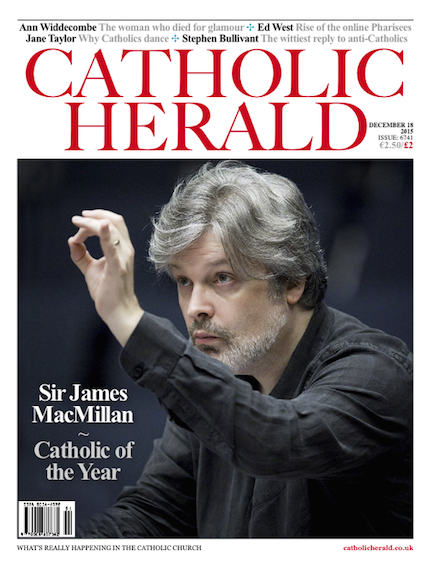
MacMillan was awarded the “Catholic Herald’s Catholic of the Year, 2015.” He is an admirer of Benedict XVI, who also places music and beauty at the core of human life. “Beauty is the heart of our Christian faith,” MacMillan wrote. “It should be paramount in our attentions as we approach the throne of all Beauty for our praises.” The Church long understood that men need beauty as much as they need bread, perhaps, in the long run, they need it more.
In The Ratzinger Report (1985), we read: “Christianity is not a philosophical speculation; it is not a construction of our mind. Christianity is not ‘our’ work; it is a Revelation; it is a message that has been consigned to us, and we have no right to reconstruct it as we like or choose.”
Popes and bishops have no more important task than to keep the essential “message” intact. “Philosophical speculations” only follow upon and aid the accurate reception of revelation and its content. Any attempt to “reconstruct” it or tone it down in the light of some fancied “construction” of the mind is itself to reject what has been “consigned” to us. It is this latter consignment, however unpopular or alien to a given culture or era, that God wanted to be kept present in the world down the ages – and entrusted the Church to carry it out.
Sir James MacMillan put it this way: “Many people, believers or not, have invested a lifetime in trying to water down Christianity, seeing a bland uniform secularism as some kind of inevitable next step. We do live in a plural society, but our civilization has been shaped by Judaeo-Christian values and culture. Some of us will continue to celebrate this and live our life of faith as pluralists.” One can hardly doubt that much of modern Protestantism and liberal Catholicism have indeed spent “lifetimes” in “watering down” the basic tenets of revelation and the reality to which they refer.
MacMillan_CH
The effort to “water-down” Christianity into a “bland uniform secularism” would make the Church an agent of cultural uniformity. The things that make Christianity distinct – its very revelation of Trinity and Incarnation – would be eliminated or explained away. This revelation and its distinctness, indeed, are popularly said to be the “cause” of our civil disorders. No one, then, can claim to be bound by anything but what the state allows for public peace. A universal “humanism” or “secularism” endeavors to eliminate any cause of strife. The Church thus can claim no effect outside its own walls. Religious freedom ends at the front door of any religious congregation.
The kind of “pluralism” that Sir James MacMillan follows is a more robust kind than the “multiculturalism” according to which we currently are ruled. Modern “multiculturalism,” the kind that Sir James rejects, is based on skepticism. Nothing in principle is true. All religious ideas are equally wrong. None can claim truth.
In the “pluralism” of Sir James MacMillan, differences in thought and ideas are not to be hidden but to be lived openly and legally. Often, to do so, it takes considerable “courage”—itself, no doubt, an historical Scot virtue. How often have the haunting bagpipes of the Scot regiments conveyed this virtue in many a strange land.
The idea that peace is achieved by the forceful removal of any sign of religion, in effect, establishes “secular humanism” as a mandatory “public faith,” all of this in the name of “multiculturalism.” Such a concept has, as it turns out, proved as lethal and as narrow as almost any past religion. Its justification, again, is the claim that nothing is true.
With Benedict, Sir James understands that his pluralism is rather based on reason. It does not deny the fanaticism in some religions that needs to be met head on. But it likewise affirms that what is revealed is to be known and lived. These are the truths that he will “continue to celebrate” and stand for within the nations, beginning with his own land.
Finally, let me repeat, with Joseph Ratzinger: “Christianity is not ‘our’ work; it is a Revelation.” And with Sir James: “Beauty is the heart of our Christian faith.