In this competition, the new providers of religious supply - from the Pentecostals and Charismatics to the New Age - have good cards to play: an extreme flexibility, a great indulgence toward expressivity.
But the traditional religious providers also have substantial resources at their disposal: a consolidated “brand,” an enormous reserve of symbols and rites, a great understanding of the local markets. This is, of course, on the condition of liberating themselves from the “old” scruples of orthodoxy and orthopraxis; on the condition that they accept having less significance in order to have more visibility.
Within Catholicism as well many religious providers have adopted and are adopting the forms of a low-intensity religion.
In this atmosphere it is no accident that the Catholic Church should develop a problem with the sacrament of marriage. This is literally inconceivable in a perspective of low-intensity religion, which instead devotes great but generic attention to the well-being of the family.
Careful consideration of the features of the religious boom currently taking place is indispensable for understanding the meaning of processes and crises like those that concern the Catholic clergy. To a large extent these processes and these crises are an expression of the attempt to assimilate Catholicism with a low-intensity religion.
And great lucidity is also required to avoid resorting to solutions that are in the spotlight today, like those that would have priestly ordination no longer reserved for celibate males. The Christian traditions that ordain married men and even women, and therefore have a proportionally larger quantity of clergy available, find themselves facing exactly the same problems and often in decidedly more acute forms.
Luca Diotallevi
Wednesday, November 26, 2014

Tuesday, November 4, 2014
Consecration of Brian.<><: October 6, 2013.


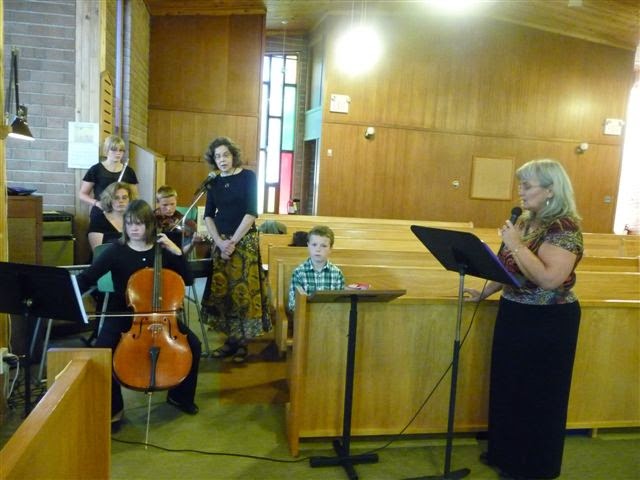
Incredible music
Mark Sanders Family
Soloist: Bernadette.

Father Rutler, an interview.
What are we not doing that we should be doing to revive Catholic life?
The first thing is to be realistic, to address the real problems in our society, secularity, instead of trying to be everything to everyone. It’s a great danger just to want to be friendly and liked instead of challenging in a prophetic way the errors of society and caving into them. St. Paul said to Timothy, “Do not be a man-pleaser." This doesn’t mean going around and hitting people over the heads with bibles, but it does mean being Catholic, right across the board…. We’ve had a secularization of religious life. Women’s religious orders are collapsing, have collapsed. Nothing was done a generation ago to discipline the orders, and to truly reform them. The ones that are growing are the ones who are faithful to their founders’ charisms.
And a primary evangelical tool of the Church is the liturgy, and wherever the liturgy is banal, you will not have vocations. In many places it’s not a problem of heresy, it’s just a matter of sloth. People are just stuck in the 1970s. Young people don’t want to go to a church where there’s a septuagenarian playing very bad Jesuit hymns from the 1960s. But many bishops don’t understand that. The liturgy has become just sort of man-focused. One giveaway is liturgies where the bishop or the priest cannot restrain himself from interjecting his own personality. They were taught to do this: greeting people, telling jokes and then thanking everybody for being there, and at the end asking applause for the choir and the ushers and everybody else. We don’t thank people for keeping the commandments! These are commandments, not propositions.
That’s people’s main contact, and I would say my vocations more than anything else came from young men’s absorption in the liturgy. And I’m not speaking about being fussy or obscurantist. I think there’s a real problem of reaction from evangelization, a real problem of nostalgia rather than tradition on the part of many people as far as the Extraordinary Form is concerned. But that’s to be expected when people have been denied their authentic Catholic roots. The danger then, of course, is...to become enclosed. Cardinal Ratzinger spoke about the danger of Mass facing the people as a kind of enclosure, whereas when the priest leads the people facing East it’s an opening to the kingdom of God. The priest facing the people becomes a kind of circular community lacking in transcendence. But a lot of people who embrace the Extraordinary Form run that risk too.They become ghettoized. It’s rather significant that in so many cases — I can’t cite numbers — but usually it’s been my experience that where the Extraordinary Form is, usually you have a static group of people, and you don’t have outreach for bringing others in.
So just using the Extraordinary Form is not the solution. What is the solution is understanding that the liturgy is God’s call to the people and the people’s response. Then you get vocations.
Another factor is the preaching, which is abysmal. We need catechetical preaching, where people get the basic doctrine of the faith. People should be leaving church having learned something.
Father Rutler
The first thing is to be realistic, to address the real problems in our society, secularity, instead of trying to be everything to everyone. It’s a great danger just to want to be friendly and liked instead of challenging in a prophetic way the errors of society and caving into them. St. Paul said to Timothy, “Do not be a man-pleaser." This doesn’t mean going around and hitting people over the heads with bibles, but it does mean being Catholic, right across the board…. We’ve had a secularization of religious life. Women’s religious orders are collapsing, have collapsed. Nothing was done a generation ago to discipline the orders, and to truly reform them. The ones that are growing are the ones who are faithful to their founders’ charisms.
And a primary evangelical tool of the Church is the liturgy, and wherever the liturgy is banal, you will not have vocations. In many places it’s not a problem of heresy, it’s just a matter of sloth. People are just stuck in the 1970s. Young people don’t want to go to a church where there’s a septuagenarian playing very bad Jesuit hymns from the 1960s. But many bishops don’t understand that. The liturgy has become just sort of man-focused. One giveaway is liturgies where the bishop or the priest cannot restrain himself from interjecting his own personality. They were taught to do this: greeting people, telling jokes and then thanking everybody for being there, and at the end asking applause for the choir and the ushers and everybody else. We don’t thank people for keeping the commandments! These are commandments, not propositions.
That’s people’s main contact, and I would say my vocations more than anything else came from young men’s absorption in the liturgy. And I’m not speaking about being fussy or obscurantist. I think there’s a real problem of reaction from evangelization, a real problem of nostalgia rather than tradition on the part of many people as far as the Extraordinary Form is concerned. But that’s to be expected when people have been denied their authentic Catholic roots. The danger then, of course, is...to become enclosed. Cardinal Ratzinger spoke about the danger of Mass facing the people as a kind of enclosure, whereas when the priest leads the people facing East it’s an opening to the kingdom of God. The priest facing the people becomes a kind of circular community lacking in transcendence. But a lot of people who embrace the Extraordinary Form run that risk too.They become ghettoized. It’s rather significant that in so many cases — I can’t cite numbers — but usually it’s been my experience that where the Extraordinary Form is, usually you have a static group of people, and you don’t have outreach for bringing others in.
So just using the Extraordinary Form is not the solution. What is the solution is understanding that the liturgy is God’s call to the people and the people’s response. Then you get vocations.
Another factor is the preaching, which is abysmal. We need catechetical preaching, where people get the basic doctrine of the faith. People should be leaving church having learned something.
Father Rutler
Friday, October 31, 2014
Wednesday, October 29, 2014
The message of Benedict XVI to Urban, religions and mission.
October 23, 2014
di Benedetto XVI
I would first like to express my heartfelt thanks to the Rector and to the academic authorities of the Pontifical Urban University More Officers and Representatives of Students, for their proposal to name to my name, the Great Hall restored. I would like to thank in a special way the Chancellor of the University, Cardinal Fernando Filoni, to have welcomed this initiative. It is a great joy for me to be so ever-present in the work of the Pontifical Urban University.
Over the course of several visits that I could do as Prefect of the Congregation for the Doctrine of the Faith, I was always impressed by the universality of that reigns in this university, where young people from almost all countries of the world are preparing for the service to the Gospel in today's world. Even today, I see inside front of me, in this hall, a community made up of many young people, and we see vividly the wonderful reality of the Catholic Church.
"Catholic": this definition of the church, which belongs to the profession of faith since ancient times, carries something of Pentecost. It reminds us that the Church of Jesus Christ was never about one people or one culture, but from the beginning it was intended to humanity. The last words Jesus said to his disciples were: "Make disciples of all nations" (Mt 28:19). And at the time of Pentecost the Apostles spoke in all languages, thus being able to demonstrate, through the power of the Holy Spirit, the full breadth of their faith.
Since then the Church has really grown on every continent. Your presence, dear students, dear students, reflects the face of the universal Church. The prophet Zechariah had announced a messianic kingdom which would go from sea to sea, and would have been a kingdom of peace (Zech 9.9s.). In fact, wherever the Eucharist is celebrated and men, with the Lord, they become one body between them, there is something of that peace which Jesus Christ had promised to give to his disciples. Dear friends, be co-operators of this peace, in a world torn and violent, it becomes increasingly urgent to build and preserve. This is why it is so important to the work of your university, in which you want to learn how to get closer to Jesus Christ to become His witnesses.
The Risen Lord commissioned his apostles, and through them the disciples of all time, to bring his word to the ends of the earth and make disciples of men. The Second Vatican Council, taking in the decree "Ad Gentes", a constant tradition, has highlighted the deep reasons for this missionary task and did so with renewed force assigned to the Church of today.
But is it really more? - Is asked by many today, both inside and outside the Church—indeed, the mission is still relevant? Would not it be more appropriate to meet in dialogue between religions together and serve the cause of peace in the world? The counter-question: Is the dialogue can replace the mission? Today, many, in fact, have the idea that religions should respect each other and, in the dialogue between them, becoming a joint peacekeeping force. In this way of thinking, most of the time it takes for the assumption that the different religions are variants of one and the same reality; that "religion" is the common gender, which takes different forms according to the different cultures, but still expresses the same reality. The question of truth, the one that originally moved the Christians more than anything else, here is put in brackets. It is assumed that the real truth about God, ultimately, is unattainable and that at best we can to make present that which is ineffable only with a variety of symbols. This renunciation of the truth seems realistic and helpful to the peace among the religions in the world.
And yet it is deadly to the faith. Indeed, faith loses its binding nature and its seriousness, if all boils down to basically interchangeable symbols, able to postpone only from afar the inaccessible mystery of the divine.
Dear friends, you see that the issue of mission places us not only to meet the basic questions of faith but also in front of that of what man is. Within a short welcome address, obviously I can not groped to analyze this issue in a comprehensive way that profoundly affects all of us today. I would, however, at least hint at the direction that should take our thinking. I do this by moving from two different starting points.
I
1 The common opinion is that religions are as it were side by side, as the continents and individual countries on the map. However, this is not accurate. Religions are moving at a historic level, as they are moving peoples and cultures. There are religions in waiting. The tribal religions are of this type: they have their moment in history, and yet they are waiting for a larger meeting that leads to fullness.
We, as Christians, we believe that, in the silence, they await the encounter with Jesus Christ, the light that comes from him, which alone can bring them fully to their truth. And Christ awaits them. The encounter with him is not the intrusion of a stranger who destroys their own culture and their own history. It is, however, the entrance into something bigger, to which they are on the way. So this meeting is always at a time, purification and maturation. Moreover, the meeting is always mutual. Christ expects their history, their wisdom, their view of things.
Today we see more and more clearly another aspect: while in the countries of its great history of Christianity in many ways has become tired and some branches of the great tree grew from the mustard seed of the Gospel have become dry and fall to the ground, the encounter with Christ of religions in waiting comes new life. Where before there was only fatigue, manifest and bring joy to new dimensions of faith.
2. The religion itself is not a unitary phenomenon. In it are always more distinct dimensions. On one side is the magnitude of reaching out beyond the world, to the eternal God. Yet, on the other hand, there are elements in it arising from the history of the men and their practice of religion. Where we can (rivenirsi) rediscover, re-find, certainly noble and beautiful things, but also low and destructive, where selfishness of man has taken possession of religion, and instead of an opening, turned it into a closure in their own space.
For this reason, religion is never simply a phenomenon only positive or only negative: in it one or the other aspect are mixed. At its beginnings, the Christian mission felt very strongly, especially the negative elements of the pagan religions in which he met. For this reason, the Christian message was at first extremely critical of religion. Only by overcoming their traditions and in part also considered demonic faith could develop its renewing power. On the basis of elements of this kind, the Protestant theologian Karl Barth put in opposition to religion and faith, judging the first in an absolutely negative as arbitrary behaviour of the man who tries, from himself, to grasp God. Dietrich Bonhoeffer has taken answer to this setting in favor of a Christianity "without religion. "It is without doubt one-sided view that can not be accepted. Yet it is fair to say that every religion, to stay in the right, at the same time must also always be critical of religion. Clearly this is true, since its inception, and according to its nature, the Christian faith, which, on the one hand, looks great compared to the deep hold and the deep richness of religions, but on the other hand, sees a critical Also what is negative. It goes without saying that the Christian faith must constantly develop the critical force also in relation to its religious history.
For us Christians, Jesus Christ is the Logos of God, the light that helps us to distinguish between the nature of religion and its distortion.
3. In our time becomes ever stronger voice for those who want to convince us that religion as such is outdated. One critical reason should guide the actions of man. Behind such views is the belief that the positivistic thought the reason in all its purity has finally acquired the domain. In fact, even this way of thinking and living is historically conditioned and tied to certain historical cultures. Consider it as the only valid belittle the man, taking away essential dimensions of its existence. Man becomes smaller, not larger, when there is no space for an ethos that, according to its true nature, to over pragmatism, when there is no more space for our gaze fixed on God. proper place of reason positivist is in the major areas of action of the technique and the economy, and yet it does not exhaust all that is human. So, it is up to us again and again that we throw open the doors, beyond mere technique and pure pragmatism, leading to all the greatness of our existence, the encounter with the living God.
II
1 These reflections, perhaps a little 'difficult, should show that even today, in a world profoundly changed, it remains reasonable to the task of communicating to others the Gospel of Jesus Christ.
And yet there is also a second way, easier to justify today this task. The joy demands to be communicated. Love demands to be communicated. The truth demands to be communicated. Who received a great joy, he can not simply keep it for themselves, they must pass it on. The same applies to the gift of love, for the gift of recognition of the truth that is manifested.
When Andrea met Christ, he could not help but say to his brother: "We have found the Messiah" (Jn 1:41). And Philip, who had been given the same meeting, he could not help but say to Nathanael that he had found him of whom Moses and the prophets had written (John 1:45). We proclaim Jesus Christ to bring to our community as many members as possible; and much less power. Let’s talk about Him because we feel we need to transmit the joy that was given to us.
We will be credible proclaimers of Jesus Christ when we have truly met in the depths of our existence, when, through the encounter with Him, we will have been given the great experience of truth, love and joy.
2. It is part of the nature of religion, the deep tension between the mystical offer to God, in which we totally over him, and responsibility for others and the world he created. Martha and Mary are always inseparable, even if, from time to time, the emphasis can fall on one or other. The meeting point between the two poles is the love in which we touch at the same time God and his creatures. "We have known and believed the love" (1 Jn 4:16): This phrase expresses the true nature of Christianity. The love that is achieved and is reflected in multifaceted way in the saints of all time, is the authentic proof of the truth of Christianity.
Benedetto XVI
http://www.korazym.org/18000/messaggio-benedetto-xvi-urbaniana-religioni-missione/
The language does not flow well because it was translated from Italian by and online translator.
b.<><
Monday, October 27, 2014
How do Law and Love relate, by John Bergsma
When the Pharisees heard that Jesus had silenced the Sadducees,
they gathered together, and one of them,
a scholar of the law tested him by asking,
"Teacher, which commandment in the law is the greatest?"
He said to him,
"You shall love the Lord, your God,
with all your heart,
with all your soul,
and with all your mind.
This is the greatest and the first commandment.
The second is like it:
You shall love your neighbor as yourself.
The whole law and the prophets depend on these two commandments."
Matthew 22:34-40:
Let’s recall where we are in the Church year. We have been working through the Gospel of Matthew throughout Ordinary Time in Year A. We have moved from the beginning of the Gospel all the way to Passion Week, and now we are in Jerusalem listening to Jesus teach and debate before he goes to his death. Last week we read about the Pharisees and Herodians questioning him about paying taxes to Caesar. After that, the Sadducees came and questioned him about marriage and the resurrection—although that unit is not read in the Year A cycle. Now, one of the better scholars among the Pharisees tests him with a question about the Law.
We should note that there is Davidic kingdom typology going on in this passage. Solomon sat on his throne in Jerusalem and was tested with hard questions from a great number of people, most notably the Queen of Sheba, who came for that very purpose (1 Kings 4:34; 10:1). The whole scenario of Jesus sitting in Jerusalem and defeating all comers with his divine wisdom fulfills the image of wise King Solomon of so many centuries before. Jesus is the greater son of David, and that concept ties in with our responsorial, Psalm 18, which was a royal Davidic Psalm. We also recall that the Law of Moses required the King to meditate constantly on the Law (or Torah; Deut 17:18-20) and thus become an expert in its concepts and application. This is what we see Jesus doing: he has brilliant insight into the interpretation of the Torah, and a very clear view of which laws express principals of primary hermeneutical importance, and which are of lesser significance. He is the Davidic king who has meditated on the Law.
Although the text says the Pharisee meant to “test” him, this question is not asked with the same ill will as the previous questions from the Pharisees and Sadducees. There is not necessarily a trap here. Rabbis debated which laws within the Torah carried precedence, and discovering the way an individual Rabbi prioritized or ranked the Mosaic laws gave insight into his interpretive approach or legal system.
Jesus replies that the greatest commandment is love of God, followed closely by love of neighbor. Our Lord’s reply is not entirely unique: other Rabbis might have given a similar or identical answer. In fact, in Mark’s fuller account of this passage, the Pharisee who asks the question agrees enthusiastically with Jesus’ response (Mark 12:28-34). Our Lord takes the first and greatest commandment from Deut 6:4-5. This is a famous passage known as the Shema, which to this day is recited multiple times a day by pious Jews, similar to the way the Our Father is recited by Christians.
The second, Love your neighbor as yourself, is taken from the so-called “Holiness Code” of Leviticus (Lev 19:18). Many think Jesus invented this law, but he is actually quoting from the Pentateuch.
It is a common misconception that by summarizing the Law with the two commands of love, Jesus was somehow making the law less challenging or demanding. That is hardly the case. Perfectly to live out love for God and love for neighbor is all-consuming and very challenging. It is also a common misconception that the Pharisees had high moral standards, and Jesus criticized them for their high standards and instead dumbed things down to a generic “niceness” to everyone. This is also a completely wrong view. The Pharisees did not necessarily have high moral standards, although some among them (like the Pharisee asking this question) were decent men. The Pharisees had rigorous ritual standards, but frequently low moral demands. Jesus primarily criticizes them for (1) hypocrisy, in holding to high ritual standards but neglecting matters of morality, or (2) using legal reasoning to create loopholes in the moral law that allow them to evade the high demands of love of God and love of neighbor.
By emphasizing that the whole law is summed up in the two commands of love, Jesus does not make it easier to fulfill the law, he makes it more challenging, because there are no loopholes in love! If the criteria for evaluation of moral behavior in any given situation is the imperative of love rather than some external physical criteria, it becomes impossible to create legal ways to evade God’s will.
Of course, love has to be properly understood. Many reduce love to an emotion, or confuse love with “niceness.” There is an emotional component of love, and love can express itself in being nice. But love has to follow truth, and it is not ultimately loving to tell people falsehoods or encourage them along a false path that will not lead to their happiness. The difficulty arises when we love someone who is engaging in self-destructive behavior, but does not realize it. And when we point it out—motivated by love—they perceive us not as loving but as hostile or narrow-minded or “traditional” or intolerant or some other category.
Let’s discuss what it means to love God with all one’s heart, soul, and mind. The heart (Gk. kardia) can be understood as the seat of the emotions or affections, so loving God with the heart means cultivating our affection and emotional attachment to him. The soul (psyche) can be understood as our spiritual nature, so loving God with one’s whole soul is seeking spiritual union with him, the “unitive way.” Loving God with the mind (dianoia) is an intellectual endeavor, seeking to know God, to understand the truth about Him, his nature, and his creation. An anti-intellectual spirituality would be a failure to love God with the mind. We can observe a rough analogy to the classic three stages of the spiritual life: the purgative involves learning to love God with the heart vs. disordered passions or desires; the illumanitive involves loving God with the mind, as our minds are enlightened with the knowledge of God; and the unitive involves spiritual union, loving God with the soul.
Jesus wasn’t a lawless hippy or an anarchist revolutionary. He respected the role of law in human society and personal life. He and his parents were careful to observe the laws in force at the time, as we see from the infancy narratives in Luke. However, Jesus stressed that the law was ordered to love, and has to be interpreted in light of love, which is more than an emotion, but fundamentally an act of the will in which we will the good of the person who is loved. Love needs to be understood as an act of the will based on truth—this is where our culture misunderstands love. In any event, Jesus taught that law was ordered to love and had to be interpreted in light of love. This is more than we can humanly live up to, which is why we need to exercise faith and receive the sacraments. Through faith and the sacraments, Jesus can fill us with his love, such that St. Paul will say:
God’s love has been poured into our hearts through the Holy Spirit which has been given to us. (Rom 5:5)
Rom. 13:8 Owe no one anything, except to love one another; for he who loves his neighbor has fulfilled the law. 9 The commandments, “You shall not commit adultery, You shall not kill, You shall not steal, You shall not covet,” and any other commandment, are summed up in this sentence, “You shall love your neighbor as yourself.” 10 Love does no wrong to a neighbor; therefore love is the fulfilling of the law.
But the love of the Holy Spirit poured into our hearts is key. We can’t live up to the command of love until we learn to love with the love of God which has been given us. Our own feeble efforts are not going to be sufficient; that would be Pelagianism.
John Bergsma
Sunday, October 26, 2014


Subscribe to:
Posts (Atom)